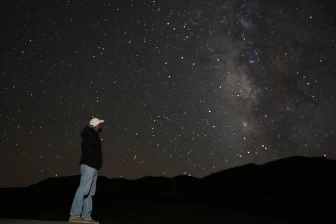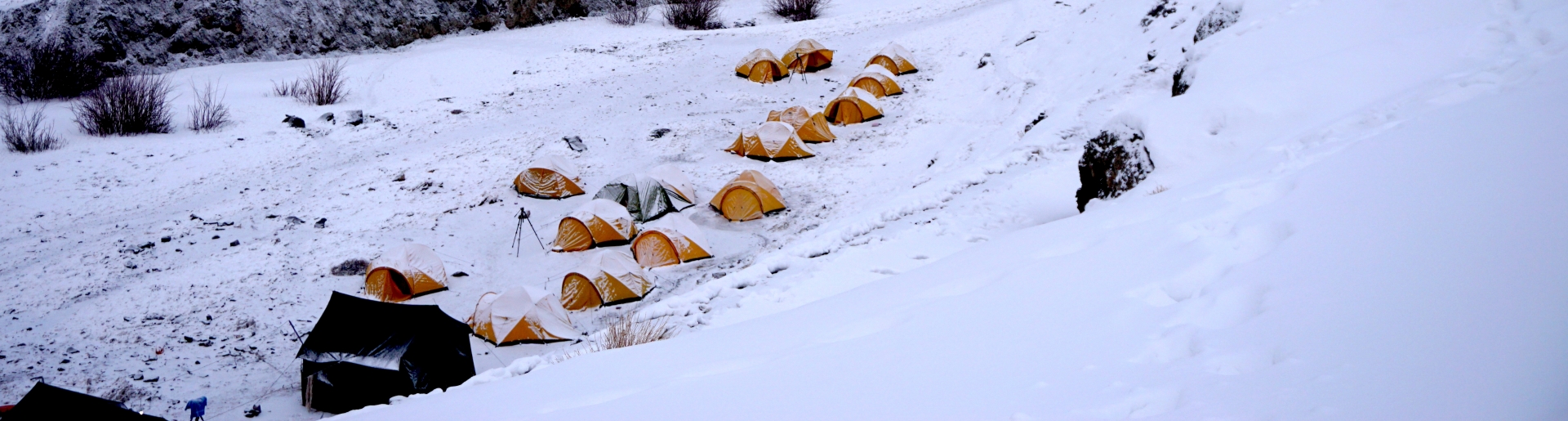
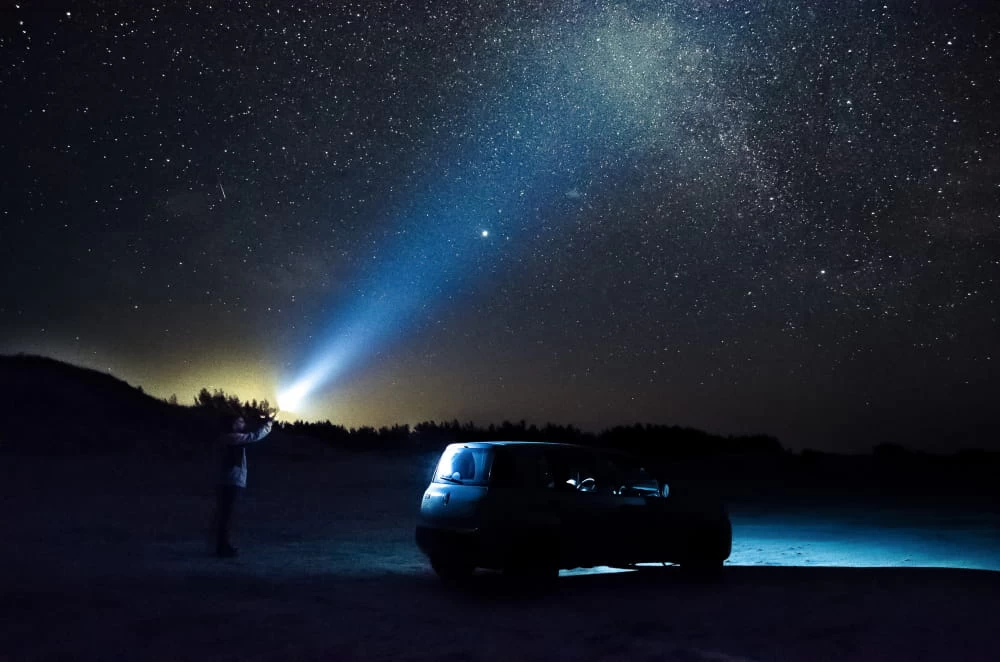
Ladakh looks completely different after sunset. The mountains turn into dark silhouettes, villages become quiet, and the sky seems much larger than it does in a city. On a clear night, stars appear in numbers that can be difficult to imagine if you are used to urban skies. This is what makes Stargazing in Ladakh such a memorable experience.
The region has several natural advantages for observing the night sky. High elevations, dry conditions, and limited artificial light create favourable viewing conditions. Hanle is particularly well known for astronomy and dark skies. It is home to the Indian Astronomical Observatory and the Hanle Dark Sky Reserve, which was established in 2022 to protect the area's exceptionally dark skies.
You do not need to be an astronomy expert either. Sometimes all you need is a warm jacket, a dark spot away from bright lights, and enough patience to let your eyes adjust.
Ladakh's geography plays a major role in the quality of its night sky. Much of the region sits at high altitude, far from large urban centres. There is less artificial light than in densely populated areas, while the cold desert climate generally brings dry air and low atmospheric moisture. The Indian Institute of Astrophysics notes that the Hanle region has low atmospheric water vapour, sparse population and generally clear skies, all of which make it particularly suitable for astronomical observation.
Light pollution matters more than many first-time stargazers realise. A city can hide thousands of stars even when the sky appears clear. Move far enough from artificial lighting and the difference is immediate.
Ladakh also has wide, open landscapes. There are fewer trees or buildings blocking the horizon, so you can look across a broad section of the sky.
Hanle stands out for travellers who want to make astronomy a major part of their Ladakh trip. Located in eastern Ladakh, Hanle is roughly 260 to 270 km from Leh and sits at around 4,200 metres, while the Indian Astronomical Observatory is situated at about 4,500 metres. The region is remote, dry and remarkably dark.
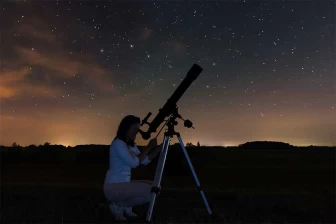
The Hanle Dark Sky Reserve was established in December 2022 and is India's first dark sky reserve. The project also involves local communities, with trained Astronomy Ambassadors providing guided sky-viewing experiences using telescopes.
Hanle is not only a place to photograph the stars. Astronomy is becoming part of the local tourism experience too.
The Indian Astronomical Observatory is a working scientific facility, and visitors should not assume they can freely enter every part of the site. Several areas are restricted, and the Indian Institute of Astrophysics asks visitors to follow site instructions and avoid activities that could create light pollution.
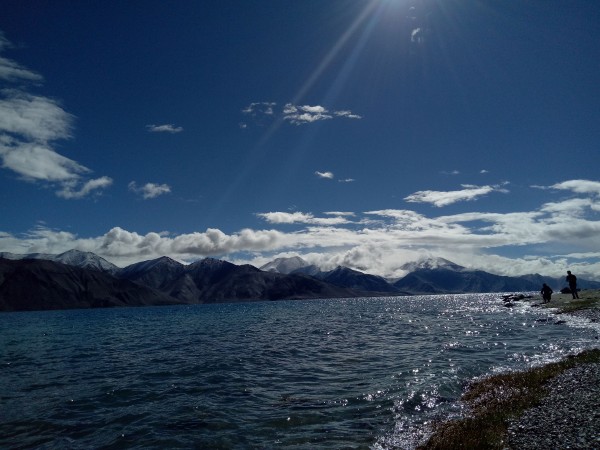
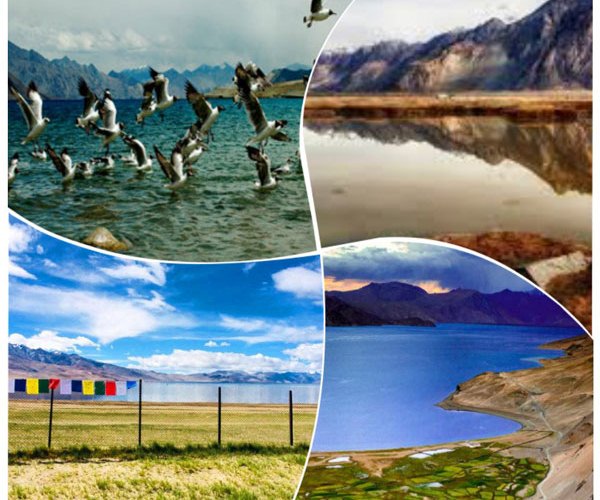
Pangong Tso is famous for its blue waters during the day, but the lake takes on a completely different character after dark.
Its remote setting and high elevation make it an appealing location for night sky photography. If you stay near the lake, move away from unnecessary lights and give your eyes time to adjust.
The lake can also become extremely cold at night. A beautiful location does not mean comfortable conditions. Warm clothing and a suitable overnight stay matter here.
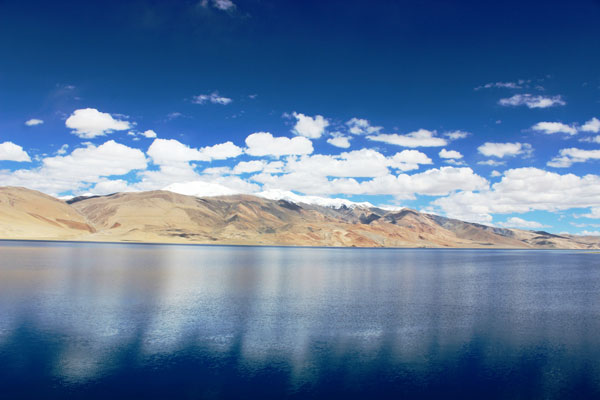
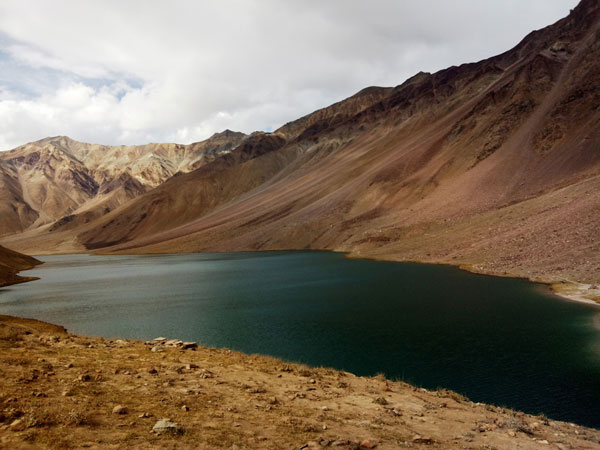
Tso Moriri is another strong option for travellers who want a quieter night away from the brighter areas of Ladakh.
The lake sits in the remote Changthang region, surrounded by mountains and open high-altitude terrain. There are fewer urban distractions, which makes the area attractive for both casual stargazing and photography.
Reaching Tso Moriri takes more planning than visiting places close to Leh. Check road conditions, accommodation availability, and current travel restrictions before setting out.
Nubra Valley offers a different kind of stargazing experience. The valley combines high mountain scenery with open desert-like landscapes, villages and monasteries. Areas away from busy settlements can provide darker skies, while the surrounding landscape gives photographers plenty of options for foreground composition.
A night under the stars here can be added to a wider Ladakh itinerary rather than planned as a dedicated astronomy trip.
A clear Ladakh sky can reveal much more than a scattering of bright stars. Depending on the season, moon phase, weather, and location, you may see:
Do not expect every night to look like a professional astrophotography image. Cameras can capture faint light over long exposures that your eyes cannot see in the same way.
Still, the naked-eye experience can be impressive. After spending a few minutes away from artificial light, your vision gradually adapts. More stars become visible. Then more again.
The best season depends on what kind of experience you want, but Overland Escape lists May to September as the ideal period for Stargazing in Ladakh, citing clear and dry conditions.
Summer also has a practical advantage. Roads and tourist facilities are more accessible than during the harshest winter months.
The moon phase is another factor worth checking. A bright full moon can wash out many faint stars and make the Milky Way harder to see. A darker moon phase is generally better if your main goal is seeing faint stars or capturing the Milky Way.
Cloud cover matters too. A perfect date on the calendar means little if the sky is covered. A useful approach is to check the moon phase and weather forecast a few days before your planned stargazing session. Keep some flexibility if your itinerary allows it.
You do not need expensive equipment to take your first night sky photographs. A camera that allows manual controls, a wide or moderately wide lens, and a sturdy tripod are enough to start. Overland Escape also notes that a manual camera, tripod and wide-angle lens are useful for astrophotography, while guided experiences may provide additional equipment.
A few practical points make a noticeable difference:
Long exposures require the camera to remain completely still. Handheld shots usually turn out blurred.
Autofocus often struggles in darkness. Focus on a distant object while there is still some light, then switch to manual focus.
Very long exposures can turn stars into short trails because of Earth's rotation. The exact exposure depends on your lens and camera settings, so take a few test shots rather than relying on one fixed setting.
A bright phone or camera screen can affect your night vision, especially when everyone around you is trying to stay in darkness.
A sky full of stars is impressive, but adding a mountain ridge, lake, or monastery silhouette gives the photograph a sense of place.
Stargazing should not be treated as an activity you squeeze in immediately after landing at Leh. Altitude comes first. Leh itself is already at a high elevation, and destinations such as Hanle, Pangong Tso and Tso Moriri are higher still. Give yourself time to acclimatise before travelling to remote, high-altitude areas.
This matters even more if you are planning a late-night session. Sitting outside in the cold at high altitude for several hours can be tiring.
A sensible itinerary could look like this:
The exact schedule should depend on your health, route, road conditions, and travel plans.
Stargazing in Ladakh can feel surprisingly cold after sunset, even when the afternoon was sunny.
Carry:
Avoid using bright white lights unnecessarily. At Hanle, this is especially important because the dark sky is part of a protected astronomy environment. The Hanle Dark Sky Reserve has a light management plan that includes measures to reduce light spill and control vehicle headlights.
A stargazing trip is still a high-altitude mountain trip.
Do not walk far from your accommodation alone at night, especially in unfamiliar terrain. Darkness can make slopes, loose ground and road edges difficult to judge.
Avoid standing close to the edge of lakes or steep drops just to get a better photograph. A dramatic foreground is never worth taking a risk.
Altitude sickness also needs to be taken seriously. Headache, nausea, dizziness, unusual weakness or breathlessness can occur at high altitude. If you feel unwell, do not treat a stargazing session as something you must complete. Get somewhere safe, rest and seek medical help when needed.
At remote locations, weather can also change quickly. Check local conditions before leaving your accommodation.
Dark skies are not just a tourism attraction. They are an environmental and scientific resource. Hanle's Dark Sky Reserve uses measures such as shielded lighting, warm-coloured bulbs and curtains to reduce unnecessary light. The programme is designed to preserve darkness for astronomy while also creating opportunities for local communities through astro-tourism.
Visitors have a role too. Keep lights switched off when they are not needed. Avoid high-beam headlights near stargazing areas. Do not leave plastic, food packaging, or other waste behind. Keep noise low, especially near villages.
And don't touch or enter restricted observatory areas. The Indian Astronomical Observatory is a working scientific facility, not simply a tourist attraction.
Ladakh is already known for dramatic roads, monasteries, lakes and mountains. The night sky adds another side to the region, making Stargazing in Ladakh a memorable experience in its own right.
Hanle is the obvious choice if astronomy is a major reason for your visit. Pangong Tso, Tso Moriri and parts of Nubra Valley can also provide memorable dark-sky experiences when conditions are right.
The key is not to chase a perfect photograph or expect a spectacular sky every single night. Give yourself time. Pick a darker location, check the moon and weather, dress properly, and let your eyes adjust. That is often when the night sky starts to feel much more impressive.
Hanle is among the best places for stargazing in Ladakh. It has very low light pollution, high elevation, the Indian Astronomical Observatory, and the Hanle Dark Sky Reserve.
May to September is a suitable period for Stargazing in Ladakh, with generally clearer and drier conditions. The moon phase and weather should also be checked before choosing a specific night.
Yes. The Milky Way can be visible from dark locations in Ladakh when the sky is clear, and artificial light and moonlight are limited. Hanle is particularly well suited for this.
No. A camera with manual controls, a suitable wide-angle lens, and a stable tripod are enough to get started. Professional equipment can produce more detailed results, but it is not essential.
Hanle is a remote, high-altitude destination, so visitors should acclimatise properly, dress for cold conditions, and follow local travel and observatory rules. Check current requirements before travelling.
Yes. Guided sky-viewing sessions in Hanle can include telescopes, allowing visitors to observe celestial objects that are difficult to see with the naked eye. These sessions are conducted through trained local Astronomy Ambassadors, so availability and arrangements should be confirmed before visiting.
Carry warm layers, gloves, comfortable shoes, water, a headlamp, a power bank, and any required personal medication. Photographers should also carry a tripod, spare batteries, and suitable camera equipment.



 Activities